They Call Me Genêt
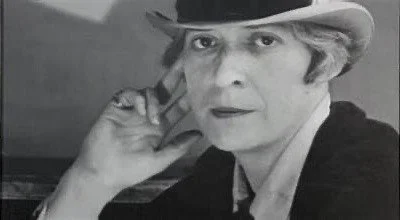
Janet Flanner — Indianapolis native, and legendary Paris correspondent for The New Yorker — is finally stepping into the local spotlight.
A Tribute to Janet Flanner and her "Letter from Paris"
July 16–19 & July 23–26, 2026
District Theatre Mainstage
627 Massachusetts Avenue, Indianapolis, IN 46204
Step into the cafés and salons of 1920s Paris in this intimate one‑woman production written and directed by D. Paul Thomas and starring Jen Johansen. For over fifty years, Janet Flanner — known to readers as "Genêt" — chronicled the pulse of Paris, capturing artists, exiles, revolutions, and the rise of modernism with unmatched elegance.
A VIP ticket grants early access to the Genêt Salon, offering a complimentary drink, pre‑show conversation, and priority seating — all inspired by the vibrant Parisian circles Flanner moved through.
Though celebrated internationally, Flanner's Indiana roots are often overlooked. "They Call Me Genêt" gives Indianapolis the opportunity to rediscover one of its most cosmopolitan and influential cultural voices.
"In Paris, the most interesting stories were often told before the evening truly began." — Janet Flanner
For more information and to purchase tickets click here
“They Call Me Genêt” has received two excellent reviews:
Tom Alvarez – On the Aisle
‘They Call Me Genêt’ Restores Hoosier Janet Flanner’s Singular Voice
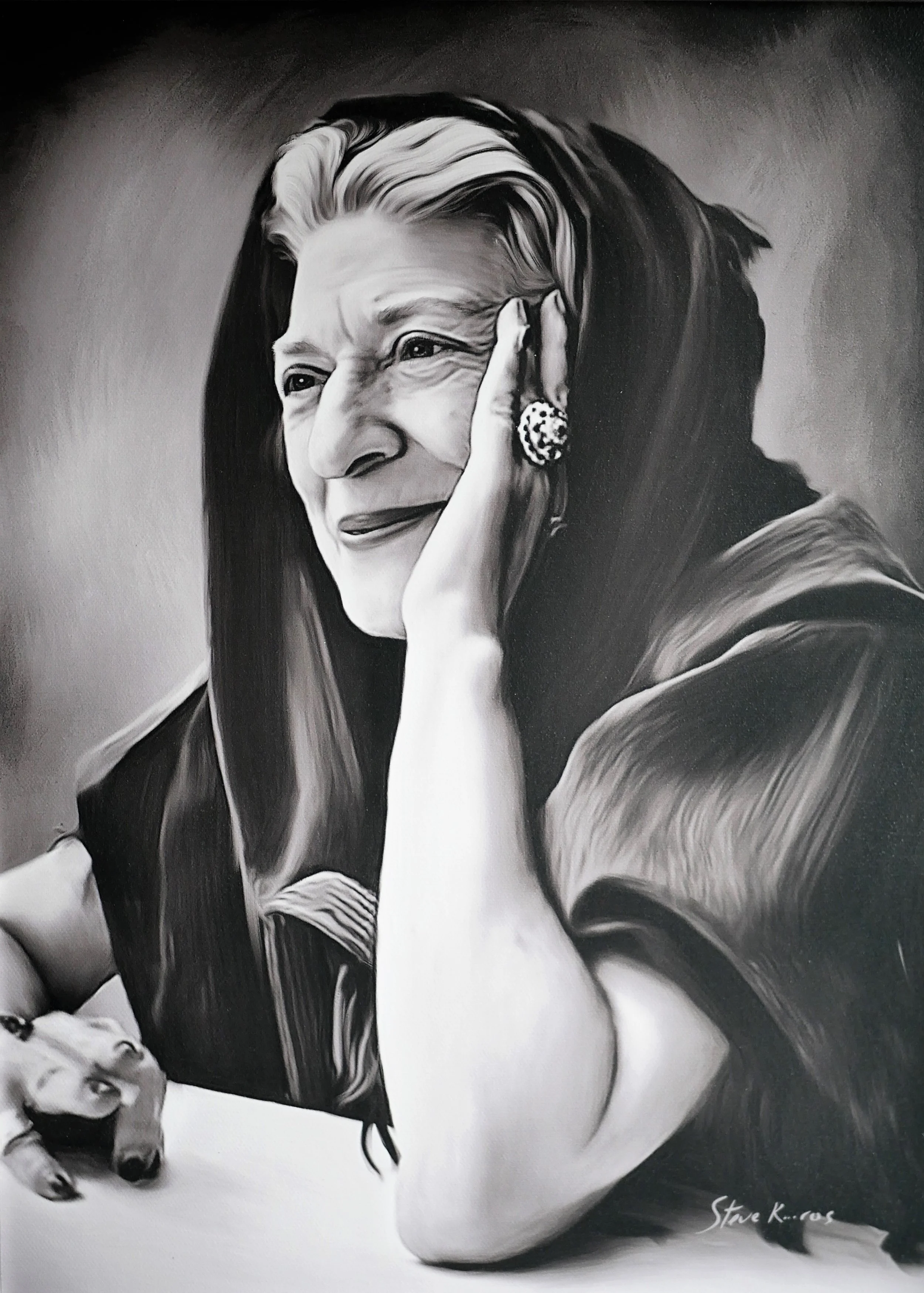
Celebrating the Legacy of
Janet “Genêt” Flanner
As a young girl growing up as part of one of Indianapolis’s leading families, Janet Flanner had a path in life already set for her by her mother, Mary, who wanted her daughter to be what she dreamed of becoming—an actress.
Janet had other plans, so, to mollify her mother, she pointed out that her prominent nose would be a barrier to any career on the stage. “I pointed out that with this nose I’d be playing Juliet’s nurse or Juliet’s nurse’s nurse, and never Juliet,” she later told a reporter from the International Herald Tribune. Instead of a life in the theater, Janet aspired to a different artistic endeavor, that of a writer.
Flanner achieved her ambition, becoming one of the stalwarts of one of America’s finest magazines, The New Yorker. From 1925 until her retirement in 1975, she produced—under the pen name Genêt—hundreds of thousands of words as the magazine’s Paris correspondent. In her “Letter from Paris” she sketched profiles for her readers of such notable figures as Pablo Picasso, Henri Matisse, Jean Cocteau, Albert Camus, and Charles de Gaulle. Her later editor at The New Yorker, William Shawn, described Flanner as “a poet among journalists.”
Fellow Hoosier author Kurt Vonnegut Jr. called Flanner one of “the most deft and charming literary stylists Indianapolis” had ever produced, as well as being the one who “came closest to being a planetary citizen, too.”
It was here in Indianapolis that Flanner’s writing career got its start. After working for a time at a reform school in Philadelphia, Flanner returned to her hometown in 1916 to work on the Indianapolis Star. Under the tutelage of the newspaper’s drama critic, Frank Tarkington Baker, she broke ground as one of the country’s first movie critics. “It was an intelligent decision for Frank Tarkington Baker [the Star’s drama critic] to treat movies, though newcomers, as important,” Flanner later told Star reporter Lawrence “Bo” Connor. Baker assigned her to review the first movie for the paper—Charlie Chaplin’s TheKid. She wrote three-quarters of a column on the film and was later delighted when her review was used to promote the movie, a common practice today.
Flanner left Indianapolis shortly after her marriage to William Rehm, a New York City artist she had known at the University of Chicago. The marriage lasted only a few years, however, and Flanner later met Solita Solano, drama editor for the New York Tribune, in Greenwich Village. The two women became partners, staying together for approximately fifty years. While in New York Flanner tried to produce freelance articles for magazines and met and became friends with the writers and critics that made up the Algonquin Round Table.
One of her friends was Jane Grant, a strong feminist and the wife of Harold Ross, later one of the founders of the sophisticated weekly magazine The New Yorker. When Solano went to Greece for an assignment in 1921, Flanner traveled with her and the two eventually settled in Paris. She quickly made connections with the expatriate literary community of the Left Bank that included such figures as Ernest Hemingway, F. Scott Fitzgerald, Ezra Pound, and Gertrude Stein.
Her fascinating life with the members of the Lost Generation and the culture and people of France were regular features of letters Flanner wrote to Grant. Impressed by her friend’s writing, Grant urged Ross to include them as a regular department in his struggling magazine. He agreed; Flanner’s first “Letter from Paris” appeared in The New Yorker’s October 10, 1925 issue. For her work, Flanner received, at first, $35 a column, a “great sum,” she noted, at that time.
Ross helped to shape the style of Flanner’s writing, cautioning her: “I’m not paying you to tell me what you think. I want to know what the French are thinking.” Every two weeks, Flanner produced 2,500 words of copy in a conversational style about significant happenings in French politics and culture under the pseudonym Genêt, a name selected by Ross that puzzled Flanner for years. “I looked up the French meanings and found three, none of which mattered,” she said. “Ross never told me what it meant. Frankly, I think he thought it was a nice French way of spelling Janet.”
Living most of the time in a room at the Hotel Continental, Flanner took her writing seriously, often preparing by reading eight different newspapers a day and pounding out her copy on an small Olivetti typewriter. “I work with a conscientious kind of discipline,” she said. “I work like a beaver, I go over each Letter for clarification, for mining, for a spot of gold.” Flanner noted she reviewed her work again and again, going over a sentence several times. “I nag it, gnaw it, pat and flatter it,” she said. Flanner became a familiar sight on Parisian streets in her tailored suits, bobbed gray hair, and monocle. “I look rather like an 18th century judge off the bench,” she observed.
Driven from Paris by the Nazi invasion during World War II, Flanner returned to the United States, living in New York. She returned to Paris in 1944, following the advancing U.S. Army as it liberated France. In addition to continuing to produce her “Letter from Paris,” she also did several weekly fifteen-minute radio broadcasts for the NBC Blue Network. The work took its toll on Flanner. “I was down to 99 pounds after those 11 months,” she noted, but added that she “liked every minute of it.”
Asked by a reporter late in her life how she accomplished all she had done through the years, Flanner noted that she was not “one of those journalists with a staff. I don’t even have a secretary. I act as a sponge. I soak it up and squeeze it out in ink every two weeks.”
Before her death on November 17, 1978, Flanner received numerous honors for her work. In 1948 the French government made her a knight of the Légion d’honneur. She also received an honorary doctorate by Smith College and in 1966 won a National Book Award for her work Paris Journal: 1944–1965. In 2009 she was posthumously elected to the Indiana Journalism Hall of Fame.
In his obituary of Flanner for The New Yorker, William Shawn, her last editor at the magazine, marveled that her eye “never became jaded, her ardor for what was new and alive never diminished, and her language remained restless. Shawn went on to describe Flanner as “an Indiana optimist perched in a small, cluttered room on the top floor of the Hotel Continental in Paris, and when she looked down over her adored city she saw, even at the most unlikely moments, reason to hope.”
- Ray Boomhower | September 23, 2023
A ground-breaking International Journalist with Hoosier Sensibilities

Life for Janet Flanner was a tapestry of episodic but inter-connected events of which she was the common thread, coursing her way through each panel in a flowingly eloquent manner. She was neither follower nor leader, but observer – her impartiality her vehicle of movement. Janet was the astute observer of a changing society, not its constant, but its indicator, grounding her ideas against the multi-faceted panoply of life between the wars, and after. She was the near-invisible foreign correspondent, choosing to be the visitor rather than the inhabitant.
- Christopher M. Connolly
Pictured: Janet’s nephew John Monhoff unveils a historic marker in Indianapolis erected in her honor in 2023.